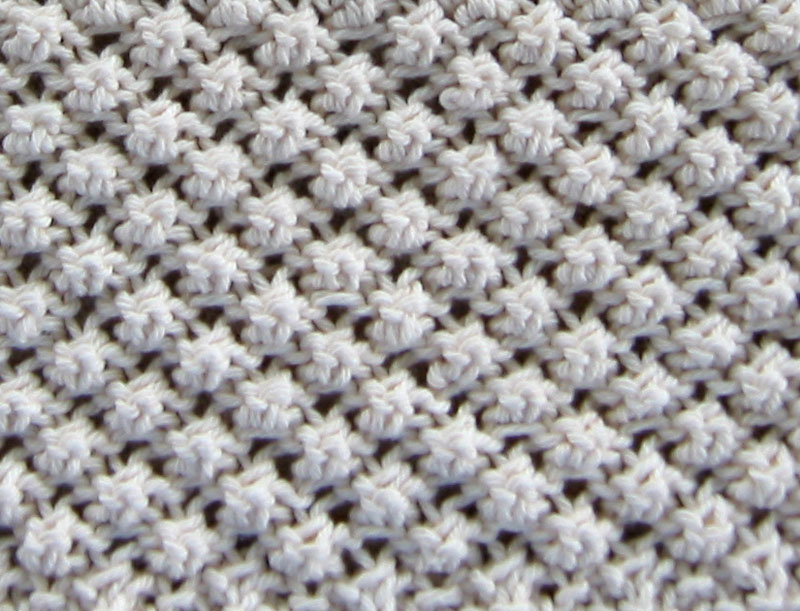
Stitch Pattern: The Trinity Stitch

Knitted Trinity Stitch

I used the Trinity Stitch pattern for dishcloth # 6. This stitch pattern produces a lovely textured fabric and is relatively easy to do. It is also known as the Cluster Stitch or Bramble Stitch. The fabric produced has a “knobby” texture and would make a lovely scarf or hat. It could also be used as part of the textured patterning in an Aran style or Fisherman style sweater or as a panel mixed with other textured patterns in an afghan or shawl.

The pattern is a multiple of 4 stitches done over 4 rows:

Row 1: (Right side) – Purl
Row 2: *(K1, P1, K1) all in same stitch, P3tog. Repeat from * across.
Row 3: Purl
Row 4: *P3tog, (K1, P1, K1) all in the same stitch. Repeat from * across.
Repeat these 4 rows for the desired length of your fabric.

Reference: Barbara G. Walker, A Treasury of Knitting Patterns

1 thought on “Stitch Pattern: The Trinity Stitch”

Comments are closed.

Related Post

WIP: Teddy Bear for GrandsonWIP: Teddy Bear for Grandson

I think every child should have a teddy bear to love, so I am knitting my baby grandson a teddy bear. The pattern is from “Knitted Toys” by Debbie Bliss. When completed, this will be about 16-19 inches — which is a good size for a teddy bear.


I initially started this project using Peaches & Cream cotton worsted yarn in teal blue. I knitted up the first leg and started on the second one — and then decided I didn’t like the way the yarn was knitting up and I also didn’t like the color for the teddy bear. So, I switched yarns and colors and started over.

The yarn I choose is Knit Picks Shine Sport yarn in Willow colorway. This first photo is of the yarn and the beginning of the right leg.

I have knitted both legs at this point and plan to work on the body tonight while watching the Olympics. I have been using right and left slanted increases and decreases to help make the shaping more defined. [One of the things that I have learned while doing the Master Knitter Level I swatches with different increases.]

Cast On MethodsCast On Methods

This is the first post about Cast Ons. There have been several books written about different cast on methods as well as many chapters in general knitting references and YouTube videos. What I know now as a long time, more experienced knitter is that there a lots and lots of different ways to accomplish the task of putting the first stitches on your needles so that you can begin to knit. But when I first started knitting, I only knew one way to cast on. That’s because, as I believe is the case for most beginners, I was only taught one way to cast on. And I suspect that my knitting teacher taught me that cast on because it was the method that she knew.

While visiting my older sister, I learned to knit from a woman who sold yarn kits and gave knitting lessons in her apartment. So, my first knitting project was a slipper pattern kit that came with the yarn, a set of needles and an easy beginner level pattern. I think I had maybe two lessons from her and I was off to knit on my own. My teacher taught me the “Knitted Cast On” method. I used this method for a long time before discovering another cast on method – the “Backwards Loop (or E-wrap)” cast on.

The first time I encountered the notion that there were other ways to cast on was when I was knitting my very first sweater and I ran into an issue and needed some help with my project. Now, I lived in a very small town and there weren’t many people who knew how to knit. My mother located a neighbor who did and was willing to help me, so I went over to her house with my sweater. The neighbor did help me get my problem fixed – but what I remember most clearly about this session was what she said about my cast on: “Oh, you cast on wrong.”

My 11 year old self didn’t comment on that statement, but I was doing a slow burn because “I DID Cast on the right way.” I had used the knitted cast on that I knew. A lot of time passed between this incident and my learning that there are many ways to accomplish the same thing in knitting. And – I am still learning different ways to cast on!

So, in this series of posts about cast ons, I will discuss the cast ons that I currently know how to do and when and with what projects I use them. Since it was the first one I learned, I’m starting with the Knitted Cast On.

The knitted cast on is an easy cast on to learn as a beginner. Essentially, you create your first stitch on your needle by making a slip knot, placing it on the needle and start the cast on by knitting  a stitch through the loop using your other needle. Once you have the stitch on the right hand needle, you slip it back onto the left hand needle and tighten it up a little, then knit into that stitch and repeat the process until you have  the desired number of stitches.

Where I use this cast on:

  • When I want a fairly firm , yet somewhat stretchy edge: project like scarves, some shawls, blankets
  • Casting on for underarm stitches or thumb gussets in gloves or mittens

Here’s a YouTube video on this cast on: Knitting Help – Knitted Cast On

Next Post: e-Wrap (Backwards Loop) and Cable Cast On Methods

Knitting Needle Sizes & ConfusionKnitting Needle Sizes & Confusion

Knitting Needles sizes are fairly straightforward in the sizes that one uses for DK, worsted weight and bulky yarns. (Size US 4 and up). But it is a much different story when it comes to small diameter needles used to knit fingering, lace and other finer weight yarns. This can be very confusing – I just discovered that there is a significant variation in the sizing labels for some of these needles.

Let’s start with the standard “US” sizing – which uses a numerical designation for knitting needles, from “0000” up to 35 – with the needle diameter increasing as the numerical designation increases. Seems like a fairly straightforward system – until you run across US size 1 & 2 needles that are different diameters. If you never use a knitting needle smaller than US size 4 (which has a diameter of 3.5 mm), this will not be a problem for you. IF, however, you get into knitting socks and lace using much smaller diameter needles – it may cause you to pull out your hair.

Fortunately, most knitting needles sold today also come with their diameter size stated as well as their US size. What I have currently in my assortment of circular knitting needles are as follows: US Size 0 (2.00 mm); US Size 1 (2.25 mm), US Size 1 (2.50 mm), US Size 2 (2.75 mm), US Size 2 (3.00 mm). These needles have all been purchased in the last 10 years. I have seen patterns referencing size 1.5 needles, so I am guessing that the size 2 (2.75 mm) needle may also be a 1.5, but it’s difficult to tell for certain. Just a word of caution to those using patterns calling for these US sizes of needles – make certain your metric diameter matches the pattern (if it’s stated) and BE SURE to check your gauge!

I found two websites that have charts comparing the US sizing to the metric diameter:
http://www.fibergypsy.com/common/needles.shtml
http://www.lionbrand.com/cgi-bin/faq-search.cgi?store=/stores/eyarn&faqKey=97

Point to remember: Gauge is the measurement of the number of stitches per inch you get with a particular needle – this is more important than using the size of needle stated in a pattern. Always do a swatch for gauge!