Knitting Socks in Waiting Area

Yesterday, I had the role of being supportive of my DH while he underwent some tests at our local hospital. (Nothing serious, just part of routine maintenance for the over 55 crowd.)

Anyway, I decided to take along a pair of socks I am knitting as my “keep occupied” project for the time I would be sitting in the waiting area. I am doing cuff down, two at a time on 2 circular knitting needles. So I pulled out my knitting and started to knit away while I sipped on a cup of coffee. An older woman walked into the group of chairs where I was sitting — and pulled out her knitting!

She was knitting something on dpn’s in a pretty dark green yarn. For a time, we sat and knit without any conversation. Then, she put away her knitting and came over and sat next to me and chatted. (I think she was anxious about whomever she was waiting for, but she never really said.) I learned that she was working on a pair of mittens and she was very curious about the method I was using for knitting socks and my self-striping yarn. We exchanged bits of information about yarns and knitting and then she was called to go back with her family member while he/she recovered.

It’s interesting how knitting forms a link and an introduction for us. I know it made the time in the waiting room go by more quickly for me and I’d like to think it eased my companion’s anxiety a little and helped her time in the waiting room pass more pleasantly.

P.S. Started the socks so that I would have an easy knit project for the knitting guild meet ups. More on the guild in another post. I promise to post a picture of the socks when done.

1 thought on “Knitting Socks in Waiting Area”

Comments are closed.

Related Post

WIP: The EZ Green SweaterWIP: The EZ Green Sweater

I have been knitting recreated Green Sweater from the pattern recreated by Sunday Holm from the original sweater knitted by Elizabeth Zimmerman. (Schoolhouse Press Pattern #13, Elizabeth Zimmermann’s Green Sweater). This sweater pattern has a charming history and you can read the story here: Channelling Elizabeth.

Now, I am a “sometimes knitter” when it comes to sweaters. I start them and I knit on them “sometimes” — for some reason, I tend to knit on my sweater projects in between other projects. This means that I take a long time to finish a sweater project once it’s started. So, I started this project over a year ago — and I knitted a portion of the lower body and then I set this project aside.

A couple of months ago, I took this project up again and knit on it quite a bit. It’s a very intriguing pattern. The sweater is knit in the round using steeks. Yes, I said steeks. Steeks are that technique that many of us knitters avoid — but one Elizabeth Z embraced and used extensively. I decided to do this sweater specifically because of the steeks — I figured it was time for me to master the use of steeks. In this pattern, there are four steeks. The first one is up the center front (the sweater is a cardigan), then there is a steek for each armhole/sleeve and the fourth one is the neckline. You basically cast-on extra stitches, in this case I cast on five for each steek, and knit them up with the sweater. Then you cut them apart in the middle. Yep — I said you cut them apart. That’s what’s scary about steeks.

Here are some pictures of this sweater in progress:
EZ Green Sweater, Center Front
This is the center front, showing the center 5 steek stitches and the beginning of the armholes for the sleeves.

EZ Green Sweater, Steeks before Cutting
This shows the sweater with all the steeks knitted, before they have been cut.

EZ Green Sweater, Steeks crocheted
I used the crocheted method for fastening the steek stitches on each side.

EZ Green Sweater, Center Steek CutEZ Green Sweater, All Steeks Cut
In these two pictures, you can see the steeks, all cut and awaiting further work.

I am now working on the first sleeve. I am about two-thirds done with it. The sleeve has a unique design, and I really like how it is knitting up. I’ll post more pictures of this sweater once I have the sleeves and the neckline knitted.

Some details: I am using Frog Tree 100% Merino Yarn in Colorway 909 Teal and using circular needles, size US 8 (5.0 mm).

Stitch Pattern: The Trinity StitchStitch Pattern: The Trinity Stitch

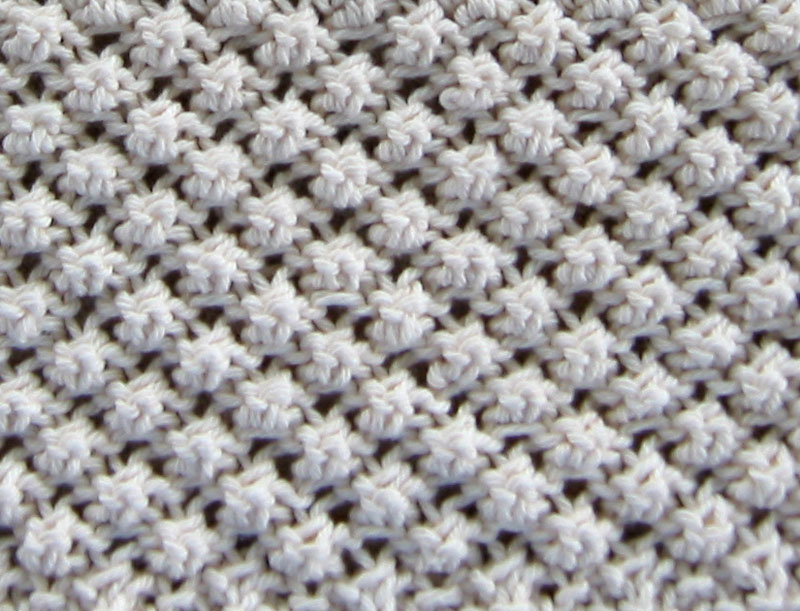
Knitted Trinity Stitch

I used the Trinity Stitch pattern for dishcloth # 6. This stitch pattern produces a lovely textured fabric and is relatively easy to do. It is also known as the Cluster Stitch or Bramble Stitch. The fabric produced has a “knobby” texture and would make a lovely scarf or hat. It could also be used as part of the textured patterning in an Aran style or Fisherman style sweater or as a panel mixed with other textured patterns in an afghan or shawl.

The pattern is a multiple of 4 stitches done over 4 rows:

Row 1: (Right side) – Purl
Row 2: *(K1, P1, K1) all in same stitch, P3tog. Repeat from * across.
Row 3: Purl
Row 4: *P3tog, (K1, P1, K1) all in the same stitch. Repeat from * across.
Repeat these 4 rows for the desired length of your fabric.

Reference: Barbara G. Walker, A Treasury of Knitting Patterns

The Roomba Ate My Socks!The Roomba Ate My Socks!

Roomba
I have a Roomba – which is a small robotic vacuum cleaner. You are supposed to be able to contain it to a single room using little devices called “lighthouses”. I really like this little guy for frequent vacuuming of my kitchen. So, the other day, I turned it on and left it to run around the kitchen while I did some things in my office.

Well, it escaped the kitchen and headed off into the living room – where my two at a time socks using magic loop project was laying beside my recliner (I’d left them there the night before) …AND…the Roomba ate my socks!

I heard this weird little sound coming from the living room and went to investigate – and there I found the Roomba thrashing about entangled in my 40” circular needle and the yarn from one of the socks. (I was so traumatized that I forgot to take a picture.)

After turning the Roomba off, it took me several minutes to remove the yarn from around the various moving parts and then deal with the fact that the circular needle had somehow ended up wrapped around one of the wheels. Eventually, I succeeded in extricating my circular needle – but it was a close call, as I had begun to consider the possibility of having to cut the cable. (WHEW!) Fortunately – one sock was still on the circular needle. The other, however, was laying in the middle of the floor – off the needle and minus its ball of yarn. I tenderly picked up this wounded creature and set it aside to recover from all the trauma.

I discovered that the lighthouse that should have prevented Roomba from going into the living room wasn’t working (dead batteries). Once I replaced the batteries, the darn little thing worked just fine and stayed in the kitchen where I wanted it to be.

Socks_BackTog
Happy News! – I was able to frog the wounded sock back to a point that I knew where I was in the pattern and then pick up the stitches and reconnect the yarn to the sock as I reknit it back to where it had been before it was attacked by the Roomba. It is now back on the same circular needle with its brother.